
17%
of UK adults volunteer monthly, down from 27% in 2014
Community Life Survey 2025, DCMS
£32bn
in social value from unused employee volunteering time
Untapped Impact, Cebr & Royal Voluntary Service
51%
of adults say work commitments are the main reason they don’t volunteer
Community Life Survey 2024/25, DCMS
The hours exist. The intention is usually there. The problem is how volunteering programmes are designed — and for whom.
This article focuses specifically on volunteering. For the broader picture of corporate giving strategy, donations and programme structure, see our guide to corporate giving for finance firms.
1. One day a year isn’t a volunteering programme
A single volunteering day looks good externally. Internally, it signals something important: this is optional, not embedded.
When volunteering is treated as a one-off event, participation is driven by whoever happens to be free that day, whoever feels socially obligated, and whoever isn’t in a critical meeting. That’s not a programme — it’s a lottery.
The Road Ahead 2025 report (NCVO) highlights that charities are already under significant capacity pressure, struggling to recruit and manage volunteers effectively. Inconsistent, one-off corporate volunteering is particularly hard for charities to absorb — it creates a planning burden with unpredictable returns.
Structured corporate volunteering programmes consistently outperform ad-hoc models in both participation and overall impact (Corporate Giving Report 2025, CAF). The shift from event to programme isn’t about doing more — it’s about doing it consistently, with intention.
Two or three planned volunteering touchpoints per year, communicated well in advance, with options that suit different schedules and preferences — that’s enough to move from one-off to embedded.
2. Employees didn’t choose the cause — so they don’t show up
The second most common volunteering failure is selecting the charity at leadership level without employee input, announcing it to staff, and then wondering why participation is low.
Engagement depends on ownership, not just awareness.
This matters particularly in finance and professional services, where employees are highly intelligent, independently minded and sceptical of anything that feels imposed on them. A cause chosen by the managing partner, however worthy, rarely generates the same response as one nominated and selected by the team.
The fix isn’t giving employees total freedom — that creates incoherence. It’s a structured process: staff nominate causes they care about, a small CSR committee curates a shortlist against a few organisational criteria, and the team votes. The result is a charity partnership that employees feel they chose — because they did.
The NCVO Road Ahead 2025 and Community Life Survey 2024/25 both point to a consistent finding: people are more likely to volunteer when they feel a personal connection to the cause. That connection doesn’t happen by announcement.
The question worth asking your team: “If you had one day to give back, what would you want it to be for?” The answers will tell you more than any leadership offsite.
3. The format doesn’t fit the working day
The Workplace Volunteering and Engagement Insight Report (SME Business News, July 2025) identifies time pressure as the leading structural barrier to employee volunteering participation — ahead of awareness, motivation or programme design.
In finance, this isn’t a minor inconvenience. It’s the defining constraint. Community Life Survey found that over half of people cite work commitments as the primary reason they don’t volunteer. In asset management and private equity, where 50–60 hour weeks are common and certain periods of the year are entirely closed off, a full volunteering day is simply inaccessible to many employees — however willing they might be.
The programmes that work in this sector are designed around these constraints from the start:
- Micro-volunteering options — skills-based tasks completed in two hours, remotely, or during a lunch break
- Calendar-aligned planning — volunteering windows built around quieter periods, away from quarter-end, results season and peak deal flow
- Flexible formats — some employees give time, others professional skills, others prefer to give financially
- Visible leadership participation — participation rates increase significantly when senior staff take part and make clear it’s genuinely supported, not just tolerated
A programme that acknowledges the reality of your employees’ working lives will always outperform one that asks people to choose between their job and their values.
4. Generic volunteering wastes what finance professionals do best
Not all volunteering is equal — and for finance firms, the gap between generic and skills-based volunteering is particularly significant.
Generic volunteering (painting community centres, packing food bank boxes, gardening) has real value. But it doesn’t draw on what your employees are actually good at. For time-poor, highly skilled professionals, spending a rare volunteering day on tasks that don’t use their expertise can feel like a poor trade — for them and for the charity.
Skills-based volunteering flips this. For finance firms, the most valuable contributions to small charities are almost always professional:
- Financial modelling and budget planning
- Governance and trustee support
- Fundraising strategy and pitch preparation
- HR systems and processes
- Compliance and risk frameworks
- Marketing, communications and digital presence
These are precisely the areas where small charities lack capacity — and where a few hours from a finance professional can have an outsized impact. The Corporate Giving Report 2025 (CAF) confirms that structured, skills-aligned volunteering increases both employee engagement and charity impact simultaneously.
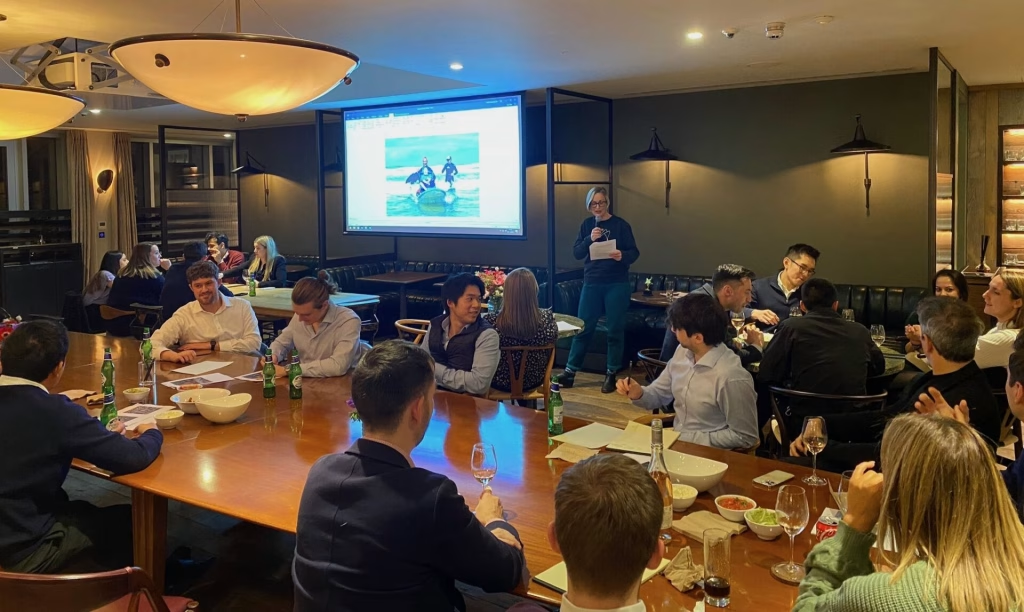
In practice, this can look like a structured, one-day problem-solving session — what we call a hackathon — built around a real operational challenge. Each year, we work with our partners to identify a genuine brief from one of our portfolio charities: a real problem that needs solving, not a manufactured exercise. For example, Marshall Wace interns tackled exactly this when they spent a day designing a tech solution to streamline admin processes for Dandelion Time, one of our portfolio charities running nature-based therapy programmes for children. A one-day project. A real brief. A solution the charity could actually use. You can read how that came together in The Dandelion Time Hackathon.
When designing volunteering opportunities, start with what your employees are good at, not with what the charity has always asked for. The best partnerships are built around a genuine skills exchange, not a transactional request for bodies on a Saturday morning.
5. The impact is never fed back to the volunteers
Employees give their time, do good work, and then hear nothing about what it produced.
Without feedback, volunteers have no way to connect their effort to an outcome. The experience remains abstract. And the next time a volunteering opportunity comes around, the vague memory of “I spent a day doing something, not sure what came of it” doesn’t motivate action.
Closing the loop is straightforward but requires intention:
- A short update from the charity four to six weeks after a volunteering day
- A specific output: “The financial model your team built helped us secure a £40,000 grant”
- A brief story shared internally — Slack, email, a team meeting — that connects the effort to the outcome
This isn’t impact reporting for external audiences. It’s closing the loop internally so that volunteers feel their time mattered. That feeling is what drives repeat participation — which is the only metric that distinguishes a programme from an event.
What effective corporate volunteering looks like in a finance firm
The volunteering programmes that work consistently in finance firms share a set of characteristics: employees had a meaningful say in choosing the cause; the format fits around how the firm actually works; professional skills are used, not set aside; and someone closes the loop after every interaction so volunteers know what their time produced.
None of this is complicated. But it requires that the programme is designed for your employees — not copied from a generic CSR playbook.
If your firm has tried to build a volunteering programme and found that people don’t show up, the problem is almost certainly structural, not motivational. Structural problems have structural solutions.
About Raise Your Hands Partners
Raise Your Hands Partners works with finance firms, asset managers and private equity houses across the UK to design corporate volunteering programmes that employees genuinely engage with. We handle everything from cause selection and skills matching to volunteer coordination and impact reporting — so the person who was handed this as a side project isn’t doing it alone.
If you’d like to explore what this could look like for your firm, we’d be glad to talk.
Sources: