
Most finance firms want to do more on social impact. That’s rarely the issue. The real problem is turning that intention into something that actually works and lasts.
This guide draws on ten years of experience building volunteering programmes with finance firms, conversations with HR leaders and managing partners, and a real case study from a firm that did it right. It’s about the gap between saying you’ll do this and actually doing it—and how to close it.
In this guide:
- Why Good Intentions Aren’t Enough — What stops programmes before they start
- What Makes Volunteering Programmes Work — The five design moves that change everything
- A Real Example: Stenham Asset Management — How one firm moved from intention to action
1. Why Good Intentions Aren’t Enough
The Intention Is Real
Let’s start here: this isn’t about getting people to care more. We’ve sat across tables from managing partners, HR directors, and office managers who genuinely care about social impact. The good intentions are there.
The issue is the gap between intention and a working programme.
Three common pathways show up again and again:
Top-down: Leadership puts a programme in place and announces it with genuine pride. And then nothing happens. No uptake. Quietly, disenchantment sets in—”we tried, our people just weren’t interested.”
Bottom-up: Employees ask for it, want it, but there’s no bridge to leadership, no one to carry it up the chain. The will is there. The structure isn’t. Disenchantment spreads through the team instead.
The pet project: One senior person is passionate and drives it personally, but never brings the team along. Expectations sky-high. When the room doesn’t match their enthusiasm, it collapses. Everyone leaves underwhelmed.
Here’s what strikes us: every one of these firms is different. But they all end up in the same disenchanted, disengaged place with their volunteering programme.
Why Programmes Plateau
The uncomfortable truth: mostly, it isn’t your people. It’s that almost nothing out there is built for a firm like yours.
Most charity volunteering infrastructure is built for scale—call centres, big retailers, thousands of staff you can send out in waves. A finance firm of thirty people gets lost in it. The maths don’t work for either side.
There are three main types of volunteering opportunities out there:
Manpower-based activities (painting, gardening, manual work) are fun for team-building, but they require a whole day out of the office. For a sector where the culture is competitive, pressurised, and target-driven, a full day away is often unrealistic for much of your team. And when you’re sending highly paid specialists to paint a fence, it can feel like a waste of their time.
Skills-based opportunities (mentoring, financial-literacy sessions, trustee roles) are emotionally where most people want to go, and the impact is real. But here’s the gap: the overlap between skills needed to work with vulnerable people and skills valued in finance is lower than people think. Money management skills don’t translate to the front line of a children’s charity. Where your people are gold is the back office—HR, marketing, digital, finance—the things every small charity is crying out for and can’t afford to buy.
Regular volunteering roles (weekly shifts, ongoing commitments) rely on people with steady time and capacity. Professionals in high-pressure environments rarely have that flexibility.
None of these fit perfectly with how a finance firm actually operates.
The Real Cost of Inaction
What does it cost to leave that good intention sitting there? More than most firms realise.
- The untapped hours: Around 140 million gifted hours went completely unused last year. That’s goodwill with nowhere to go.
- The talent cost: Social impact is now a key factor in what makes candidates pick a company and what keeps them there. When your programme doesn’t deliver, you’re losing an edge on retention and recruitment.
- The sector loss: Every finance professional who never volunteers is a set of skills the charity sector simply never gets. Finance skills are rare and valuable where they’re needed most.
- The investor cost: ESG has shifted. Investors no longer just care about the “E.” They want to see what a firm actually does on the social side—how you behave as a business. Firms with nothing real to show are quietly losing a reporting opportunity and a reputational one, and most don’t know it’s happening.
It Isn’t About Money or Apps
When firms struggle, they often reach for a fix: an app, a platform, a bigger budget. They search “charity volunteering,” find databases filled with options, and assume that’s the problem.
But here’s what research actually shows: When firms themselves are asked why their programmes underperform, the reasons are almost never about money. They’re about friction. No flexible options. Can’t find the right opportunities. Don’t know where to start.
That’s not a spending problem. That’s a design problem.
2. What Makes Volunteering Programmes Work
If design is the issue, what does good design look like?

1. Set Clear Expectations From the Start
Start by asking: Why are we doing this? What’s the driver? Where are we starting from? What would “good” look like for our firm?
Don’t measure success by “did the whole company turn up.” That guarantees you’ll feel like you failed. Instead, think differently:
If eight people out of forty participate, that’s a success—not a failure. In a high-pressure finance environment, if more than 20% of your firm walked away from their desks, the business would collapse. So 20% choosing to give their time is remarkable.
Track engagement across the whole year, not just one moment. Some people join at Christmas, a completely different group in the summer. That’s healthy—you’re reaching different people at different points.
After every activity, close the loop. Report back to the team. Share thank-yous from the children or parents. Show photos of what changed. This is what embeds the habit. One firm we know runs the same activity with the same small charity year after year—by year three it’s a tradition. People know what to expect, and they feel genuinely invested.
And be honest about longevity. An ongoing relationship is how participation compounds and how this becomes part of culture. While the rotating “charity of the year” model is understandable, it’s exhausting and rarely impactful for either partner. A minimum two-to-three-year partnership is where real impact starts to build.
2. Allocate Real Budget
This shouldn’t be a standalone point, but it is crucial: time is not enough. Allocate actual budget.
You’d spend money on team socials. Spend money on this—it’s culturally just as important. Charities have opportunity costs. Hosting volunteers takes time and resources. Without a budget behind your programme, it simply isn’t set up to succeed.
3. Make It Easy
The practical question every firm asks: who runs this day to day? And this is where most in-house efforts quietly break.
Usually it lands on an HR manager or office manager—always on top of their real job. They don’t have the time to run volunteering properly, let alone the specialist knowledge to know if a charity is “the right” one. Choosing the right charity is genuinely important. Building that relationship from the outset and aligning values and expectations is the key to creating something real.
Don’t leave employees to scroll through a massive national database of 168,000+ registered charities and pick one. That’s overwhelming. Don’t leave them to research your chosen charity on their own either. If you’ve chosen it, tell them why. Educate them. Make them part of the mission.
Either build volunteering properly into someone’s actual job description and targets (not a favour they do on the side), or outsource it to someone with the expertise to handle the recruitment, communications, coordination, and charity relationships.
4. Offer a Range of Volunteering Types
A lot of firms go wrong by offering only one flavour.
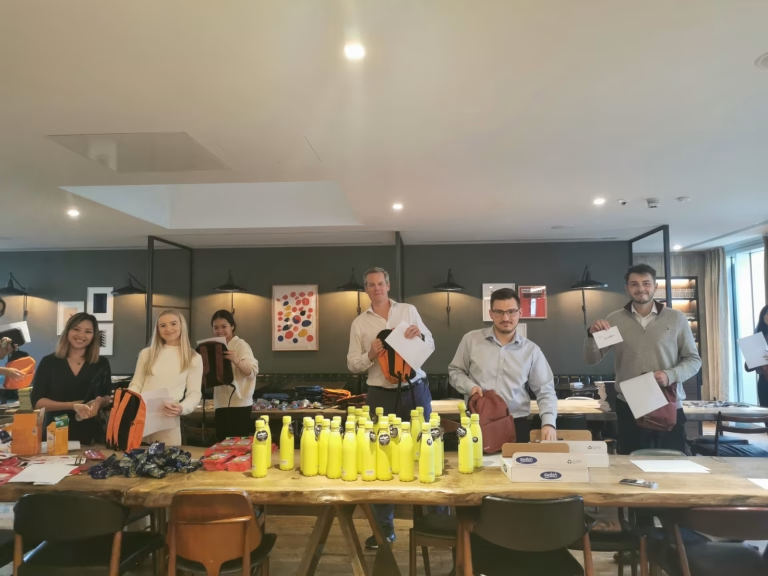
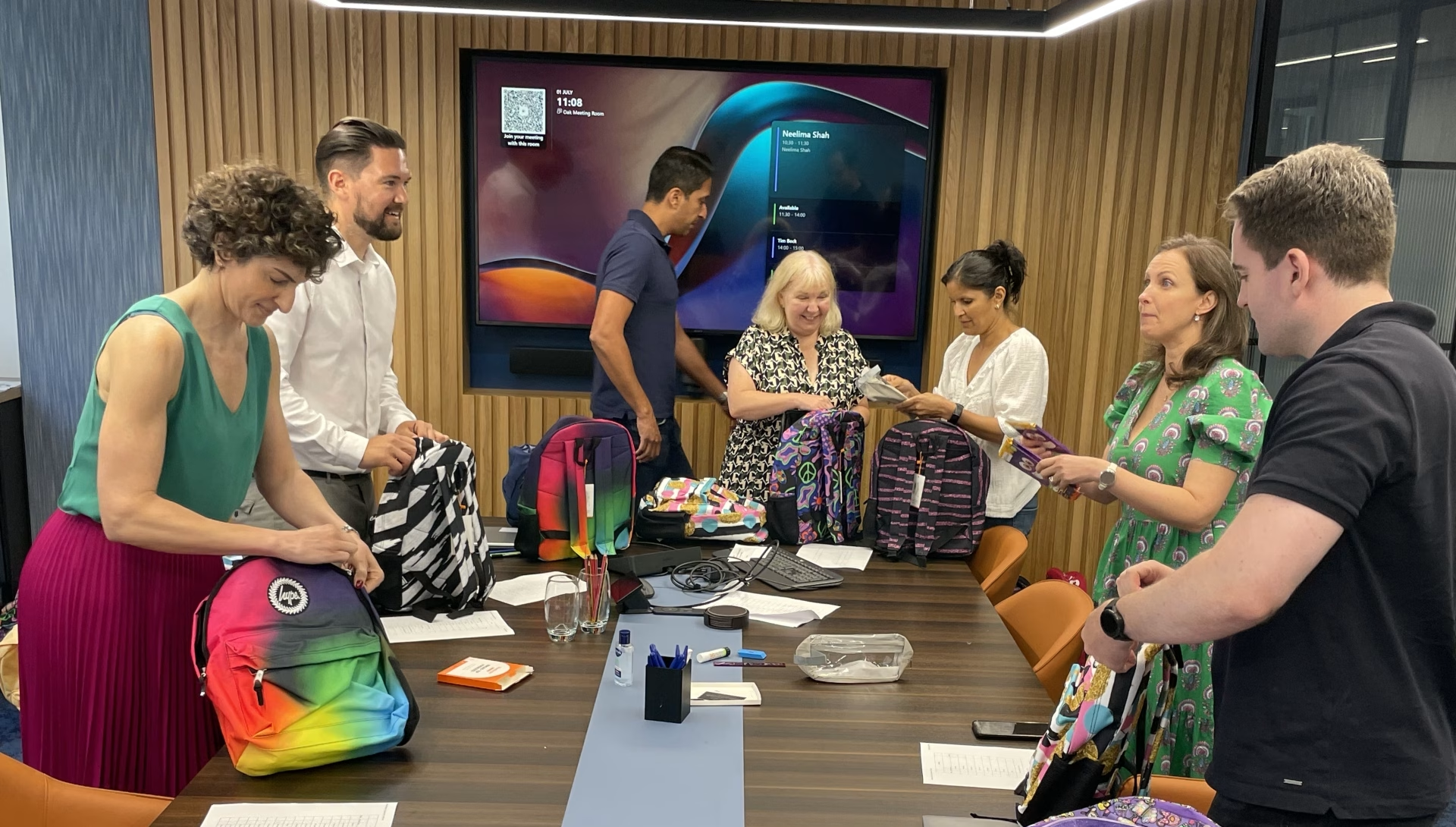
Task-based activities (wrapping Christmas presents, filling school bags, gardening) are tangible and immediate. You walk away having clearly made a difference. That feeling is real and matters. For many people, this is the draw.
Skills-based volunteering (mentoring, financial-literacy sessions, trustee roles, hackathons) appeals to people who want to get their teeth into something. When done right, it’s invaluable to charities. A hackathon with eight interns might be a fun afternoon for them, but for a charity stuck on a problem, it’s eight sharp minds actually solving something they’ve been stuck on.
The two aren’t a hierarchy. They’re a range. Task-based activities bring the workforce together—team-building, connecting, learning happen there. They build appetite to do more. Different people enter at different points.
One rule before you book anything: is it actually helpful to the charity? Be humble enough to ask what they genuinely need. Sometimes the honest answer is that a donation would do more good than a day of hands. Be prepared to walk away if what you’re offering isn’t what they need. Your employees will see straight through performative volunteering.
5. Make Leadership Visible
We see the highest participation—every time—when the senior team is visibly present. Even if it’s just for the introduction. It doesn’t need to be the whole hour. Their people simply need to see or hear from leadership demonstrating this matters.
In smaller firms this matters more than anywhere else. What leadership does with its own time is the culture. There’s nowhere to hide, and that’s an advantage if you use it right.
3. A Real Example—Stenham Asset Management
This is where theory meets practice.
Neelima Shah is HR Director at Stenham Asset Management, a £2.5bn independent investment manager with around eleven people. Like most firms, Stenham had the intention but lacked the structure. Here’s how Neelima changed that.
The Situation Before
Before building their formal social impact programme, Stenham had tried previous initiatives that didn’t scale. They had genuine commitment from leadership—both their old and new CEO are massive proponents of social impact—but the structure to make it work wasn’t there.
The early concerns were the usual ones: time (we’re a small, lean team), cost, choosing the right charities, whether people would actually engage, and how to coordinate across multiple locations.
What Changed
Working with Raise Your Hands, they moved from good intentions to a working, embedded programme. The account-management relationship was designed around Stenham specifically—not a one-size-fits-all approach, but something flexible enough for a small team with demanding day jobs.
One particular insight: they realised they needed to cater for employees who weren’t always in the London office. A virtual opportunity (Literacy Pirates’ remote sessions) opened up participation to their other offices, widening reach across the whole team and showing they were thinking of everyone.
Why It Worked
Two things stood out:
Senior leadership buy-in. Both their old and new CEO show up consistently. That sets the tone for the entire culture. People see it matters.
Flexibility. The programme was structured around how Stenham actually operates—not asking them to fit into a template. It offered choice, short time commitments, and a range of activities. That fit matched their needs and ambitions.
What It Means Now
Internally, the programme has become part of how Stenham thinks about itself. Externally, it’s a genuine story they can tell investors and partners. It’s proof of how they behave as a business—not just what they say, but what they do.

About Raise Your Hands Partners
We’re a UK-based social impact consultancy working exclusively with finance firms, asset managers, and PE houses to build bespoke corporate giving and volunteering programmes. Since 2015, we’ve directed over £4M to a vetted portfolio of 16 high-impact small charities supporting children and young people across the UK.
If the gap between wanting to do this and actually doing it resonates with where your firm is right now, we’d love to have a conversation.
Sources
- CAF Corporate Giving Report 2025, Charities Aid Foundation (Sept 2025). Survey of 1,085 UK businesses, April 2025. https://www.cafonline.org/insights/research/corporate-giving-report-2025
- “Employee volunteering: the untapped £32.5bn opportunity for the UK economy”, Cebr for Royal Voluntary Service (June 2025). Censuswide survey of 1,000 UK HR decision-makers and 2,002 UK adults, Feb–Mar 2025. https://www.royalvoluntaryservice.org.uk/news/volunteering/employee-volunteering-the-untapped-325bn-opportunity-for-the-uk-economy/
- “UK employees warn of rising disengagement”, Royal Voluntary Service / GoVo (Feb 2026). 3Gem survey of 2,000 UK adults, Jan–Feb 2026. https://www.royalvoluntaryservice.org.uk/news/govo/uk-employees-warn-of-rising-disengagement/
- Community Life Survey 2024/25 — Volunteering and charitable giving, DCMS (published Dec 2025), England. https://www.gov.uk/government/statistics/community-life-survey-202425-annual-publication
- The Road Ahead 2025, NCVO (April 2025). https://www.ncvo.org.uk/news-and-insights/news-index/the-road-ahead-2025/
- UK Civil Society Almanac, NCVO. https://www.ncvo.org.uk/news-and-insights/news-index/uk-civil-society-almanac-2024/
- The Road Ahead 2025 — “the big squeeze”, NCVO (April 2025). https://www.ncvo.org.uk/news-and-insights/news-index/the-road-ahead-2025/challenges/
- “Volunteering can boost staff engagement and retention, say HR leaders”, People Management / CIPD (2025). https://www.peoplemanagement.co.uk/article/1964388/volunteering-boost-staff-engagement-retention-say-hr-leaders